- This article is about the artificial humans named after the Seven Deadly Sins or created by the military. For the manga and 2009 anime storyline antagonist who went by this name, see Father.

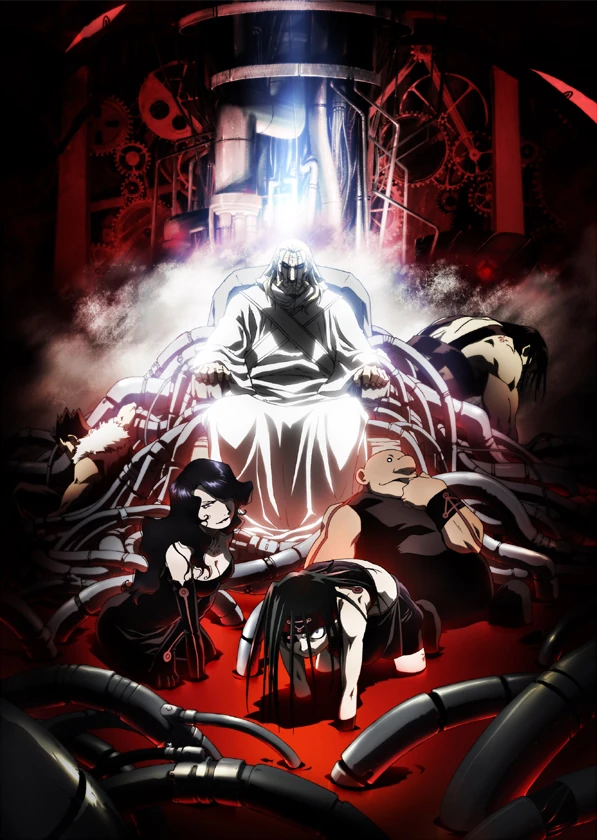

A homunculus (
Though it is a concept known of by many Alchemists in Amestris, the idea of the homunculus is typically regarded as no more than a farce or faraway fantasy as no individual or group of alchemists has come anywhere close to successfully creating such a being in officially recorded history. Even so, alchemists have been forbidden by the Amestrian government to attempt or research the transmutation of humans and State Alchemists have such a restriction as part of their creed.
However, off the official record, not only one but several of these creatures have been created in arcane, sinister secrecy. In the most relevant sense of the word, "homunculus" refers to the eight individuals who make up the primary antagonistic force of the Fullmetal Alchemist series. The homunculi created by Father (with the sole exception of Pride) carry the mark of the Ouroboros upon their bodies and are identified as such by said mark. They are named after the seven deadly sins: Pride, Lust, Greed, Gluttony, Wrath, Sloth, and Envy. They also share the same black hair. In the manga, Arakawa mostly depicted the homunculi's eyes as purple, but in the 2009 anime the homunculi have different eye colors. The first Greed's, Envy's, and Pride's eyes are shades of purple, Lust's and LinGreed's are red-violet, Wrath's are blue-green, and Sloth and Gluttony both have small, blank, white eyes. The homunculi's eyes do appear to glow red sometimes; however, whether this a trait they share or just used for dramatic effect is unknown.
The seven key homunculi created in the series are referred to as the "Sins".[citation needed]
Manga and 2009 anime
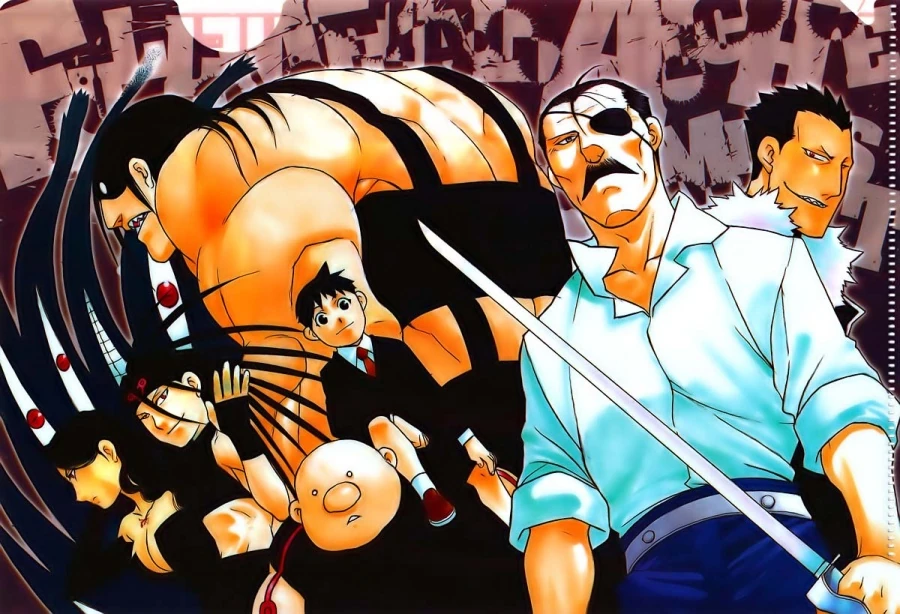

The first seven homunculi created by Father.
In the manga and 2009 anime, the homunculi are the primary villainous force of the series. The central antagonist is the original homunculus known simply as Father, who was created several hundred years before the start of the series in the presently non-existent nation of Xerxes. The other seven homunculi are tangible embodiments of his vices of human nature, and therefore were originally parts of himself. He did this in an effort to become the perfect being by attempting to purge himself of the seven "sins" which he believed make humans imperfect. The souls of the seven homunculus (Pride, Lust, Greed, Gluttony, Wrath, Sloth, and Envy) were created when Father purged his immortal soul of these seven desires that he believed prevented him from becoming a superior being to mankind.
In Xerxes, Father used half of the country's population to create his "container", which was in reality is a pale copy of Van Hohenheim. Hohenheim (originally known only as Slave Number 23) was a former slave turned brilliant Alchemist whose blood was originally used to create Father (back then referred to simply as "The Dwarf in the Flask") by the King of Xerxes's chief Alchemist during an experiment. By using the souls from the population of Xerxes, Father himself became a sort of living Philosopher's Stone and thus gained an immortal body, as well as the ability to create other homunculi like himself by dividing those same souls to create other Philosopher's Stones.
The homunculi were created by injecting a Philosopher's Stone (containing some of the souls of Xerxes and one of Father's seven vices) broken off from Father's own Philosopher's Stone, into the body of a living being. Five of the homunculi are based on (and have exactly the same composition as) humans, which were either artificial bodies transmuted from Father or naturally occurring humans; Envy is based on a disturbing leviathan creature created by Father; and Pride is created from Father's own essence, being, and image.
Some homunculi, upon having their Philosopher's Stone cores almost completely depleted, transform into their "true form", a physical amalgam of their deepest, innermost, pure, and true desires and wishes. All homunculi (with the exception of Wrath) dissolve to dust whenever they reach their true death.
Human-Based Homunculi
A secondary method of creating a homunculi is by injecting a Philosopher's Stone directly into the bloodstream of a human host. Due to the extremely volatile and powerful nature of the stone, the human body naturally rejects the foreign element, typically resulting in the host's death, wherein the Philosopher's Stone can be recollected.
If the host body survives the integration, the surviving host gains the subsequent power of a homunculus. However, the original host body usually loses control of their body, with the personality of the new homunculus taking control if the host is not strong enough.
Physical Characteristics
For the most part, the homunculi were visually indistinguishable from humans and could easily disguise themselves in human society. Homunculi are also said to be biologically incapable of reproducing.[citation needed] Among the homunculi were a fair amount of similar physical traits such as dark hair, purple eyes, and distinctive red nodes throughout their bodies (although there were homunculi that did not have these traits). While human-looking at first, some of the homunculi possessed "true forms" that bared no resemblance to humans and had little in common with each other, taking on unique appearances to each individual. On each homunculi apart from Pride was the Ouroboros mark. Although they were commonly referred to as tattoos, they were more supernatural in nature, simply appearing on the bodies of the homunculi upon creation as if a birthmark.
As they were comprised of immense energy sources from the Philosopher's Stone, the homunculi did not age and possessed incredible physical abilities. Though individual qualities differed between specific homunculi, they were generally faster, stronger, and more agile than humans. Most of all was their immense healing abilities. Incapable of death as long as their Philosopher's Stone still had souls, the homunculi could heal from any injury no matter how severe within seconds. Even the destruction of their entire bodies could not kill them, as they would always regenerate from the core that was their Philosopher's Stone. Still, although they appeared to be unkillable, they were not immortal. They could only heal so long as their internal stone supplied them energy and once their stone was depleted, they could be killed. Homunculi did bleed, but any part of their body such as blood or severed limbs (and eventually their bodies upon death) would fade away into dust, similar to the destruction of a Philosopher's Stone. The homunculi were never shown to eat, drink, or sleep and presumably did not need to (although Sloth did imply that they were still capable of sleep).[citation needed]
Psychological Characteristics
Aside from the primary emotion/desire they embody, homunculi generally possess the belief that they are superior to every other living thing, including humans. This is the psychological effect of them being born with immense strengths. Many of the homunculi even have ill feelings towards humans. Out of the homunculi, the sadistic Envy is the one who hates and treats them the most personally and with utmost bitterness, while Pride has the evilest malice, disdain, discrimination, prejudice and contempt towards humans. Greed is the only homunculus that does not truly hate humans in any respect, although it is unclear what he really thought of them before being bonded with Ling Yao, but he instead desired friends among them due to wanting everything out of life, including true happiness.
Mannequin Soldiers
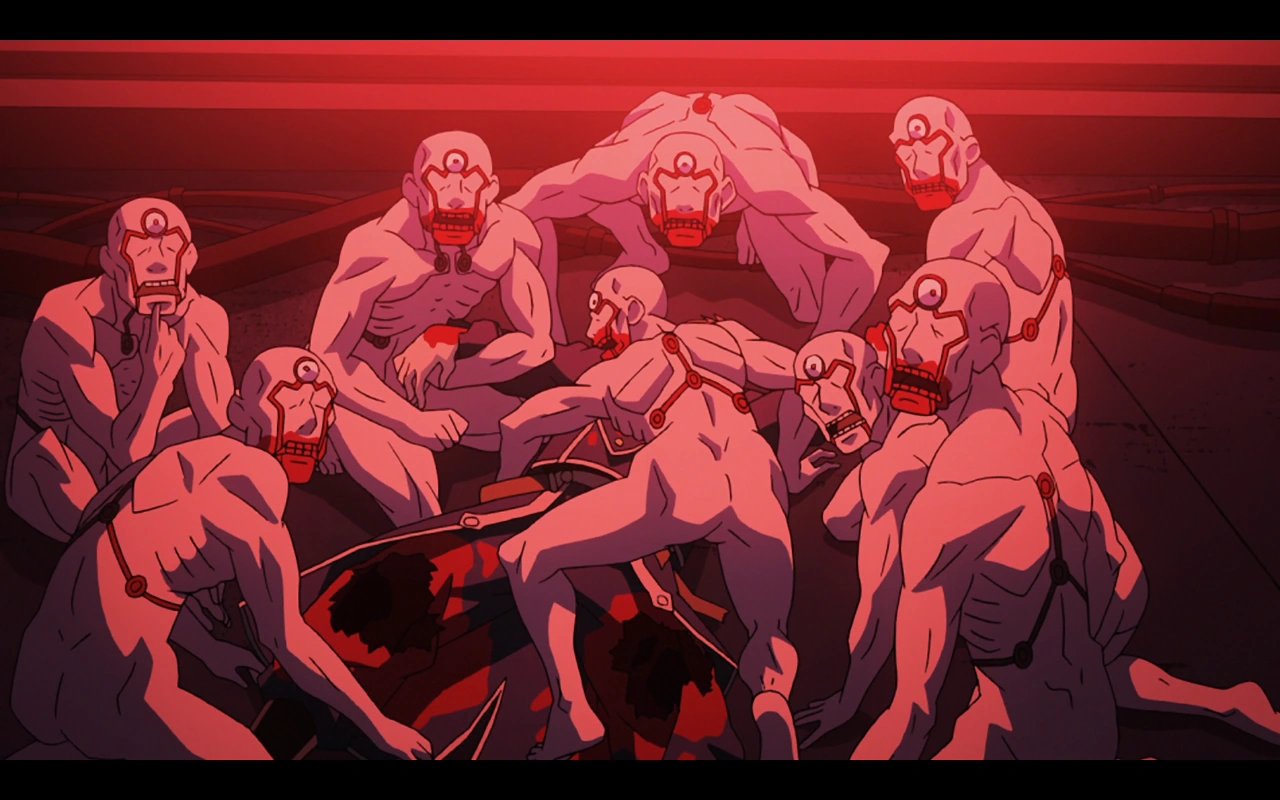

The lesser homunculi swarming over a victim.
In Chapter 80, it is revealed that the Amestrian government, presumably under the supervision of Father, has created an army of lesser homunculi whose soulless bodies are stored beneath Central Command. They are then injected with Philosopher's Stones, giving them life. These "Mannequin Soldier" homunculi are white and red, skeletally thin, hairless humanoids with one eye in their foreheads and green "blood". They lack intelligence and appear only to follow base instincts toward feeding and destruction, similar to the souls within the Philosopher's Stones who have long since forgotten their true identities. Envy at one point describes them as mere puppets injected with Philosopher's Stones. Their main attack is to try to eat their victim, since they lack the thoughts of doing much else. Envy also uses their bodies and their souls to recreate his original body after being reduced to a small parasite from having his own Philosopher's Stone drained. They do not regenerate as Father's children do, but are able to keep functioning even if their heads are grievously damaged. They seem to make similar vocalizations to the souls of the people of Xerxes trapped in Envy (crying out for help or relations and complaining that they are in pain), but they seem to want to get rid of their 'pain' by eating everything except each other.
They are awakened in Chapter 90 by one of the generals of Central Command in an attempt to quell the insurrection going on in the city. For this foolish act, he is devoured by the monsters, who have no sense of loyalty or authority. From there, these Mannequin Soldiers begin to spread about the Central Command grounds, devouring anyone they come across. Major General Armstrong manages to remove several of them as a threat by severing their heads, at least at the upper jaw, leaving them mobile, but unable to eat anyone. Colonel Roy Mustang devises his own method of incapacitating them by burning off their legs with Flame Alchemy (in the 2009 anime version, he instead incinerates them completely to ash).
2003 Anime
Because of the divergence in plotline in the 2003 anime, the origins, identities, and secrets of homunculi differ from those of the manga and second television series.
Creation
In the 2003 anime, homunculi are said to be created each time an alchemist attempts a Human Transmutation. While the transmutation itself will result in a failure in that the person intended to be revived does not return as expected, a new existence is brought about. The result of the failed Human Transmutation will be a grotesque, vaguely humanoid monstrosity retaining the genetic material, as well as some of the memory, of the resurrected. The "failed" homunculus generally remains in this agonizing state until it dies soon after. However, newly created homunculi who come into contact with Red Stones—much weaker versions of the Philosopher's Stone created by condensing human souls—and consume large amounts of them will have their bodies reshaped into their intended forms and become exact physical replicas of the people they were meant to replace.
The English dub of the anime goes so far as to state that homunculi aren't failed human transmutations, but that they are simply incomplete.
Physical Characteristics
Homunculi all carry the form of human beings, albeit some of them with exaggerated features. Some of them have cat-like slits for pupils, pointed teeth, pale skin, and each are marked with an Ouroboros tattoo somewhere on their body. The placement of their tattoo is often in accordance with the sin they represent (Greed's is on his hand, Gluttony's on his tongue, King Bradley's is on his eye underneath the eyepatch, and Lust's is right above her cleavage).
Although they are shown to eat, drink and sleep, it is not necessary that they do so in order to survive; they need only the energy provided them by the red stones they have consumed. It is likely the red "nodes" that homunculi have across their limbs circulate this seemingly endless energy.[citation needed] Just like their manga/2009 counterparts, homunculi are also biologically infertile and unable to bear offspring despite carrying human forms.[citation needed]
Despite being replicate humans, however, homunculi are still aberrations of nature created by violating the laws of the natural universe, and as such, have no souls. This property gives them many physical dissimilarities to ensouled humans:
- Super-Human Abilities: Homunculi are physically superior to humans in every way. Their bodies are faster, stronger, and far more resilient than normal human bodies. They do not age (in most cases), are immune to all sicknesses and poisons, and can heal from any injury—even those resulting in death—as long as the energy from the red stones they consume is not depleted. Examples are severed limbs and even heads growing back in a matter of seconds.
- Molecular Mutability: Because their bodies do not have souls, the constituent molecules that constitute the homunculi's bodies can be rearranged to form other substances or to grant shape-changing abilities. The homunculus Greed is able to rearrange the carbon bonds in his skin to turn it into diamond-hard armor; Gluttony's saliva is acidic enough for him to bite and chew through and digest substances of any hardness; Lust is able to change the shape of her fingers and form them into long-reaching lance-like weapons; and Envy can change the shape of his body into the form of any person or animal, or even into crude weaponry. For some reason, this ability gives all of the homunculi the ability to create their own clothing. It is black and can either cover or remain beneath the red circle patterns that decorate their limbs.
However, soullessness also acts as a disadvantage for the homunculi. - Non-Alchemists: Because homunculi do not have souls, they are incapable of opening the Gate inside them and are thus unable to perform alchemy. The sole exception to this is Wrath, who is only able to perform alchemy because he possesses Edward Elric's lost limbs. (However, he eventually loses Edward's limbs, and as a result, the ability to perform alchemy.)
- Artificiality: Because the homunculi are creatures created to replace certain individuals who have died, coming into proximity with that person's remains results in the homunculus becoming weakened to the point of immobility. Lust is shown to even faint when brought close to a lock of hair belonging to her original identity. Wrath is the only known exception to this rule because he was actually transmuted from his own remains.
- The severity of reaction to their respective human-based remains appears to differ between homunculi, and is also affected greatly by how close they are to them. Sloth and Lust were shown to be completely paralyzed when even near a small remnant of their original beings. In contrast, the homunculus Pride was revealed to handle his remains and would retain this ability, although being greatly troubled physically, so long as he couldn't directly see them. In his battle with Mustang, he possessed enough strength to strangle his son with the nearby skull hidden, but was immobilized entirely when Mustang brought it into view (it's possible that he used up his remaining strength murdering his son). Greed was also shown to show at least some maneuverability when exposed to bodily remains in Dante's mansion, although he was still greatly weakened. It's unknown how severely Envy and Gluttony would react to their original bodies if in their proximity, although it can be assumed that Envy possesses a similar capacity to Pride based on his strength and high ranking in Dante's faction. Gluttony's outcome is even more enigmatic. Seeing as how his body has undergone numerous changes over his existence, he may experience a different physical response to his counterpart's.
- Depleted Life Energy: If a homunculus is depleted of the energy of the red stones they consume, they are reduced to having a single life, making them as vulnerable as any other creature. This can be done by killing them repeatedly or by utilizing the Flamel transmutation, which causes the red stones in the homunculus to be regurgitated and then disintegrate, leaving the homunculus with only its original life intact. Homunculi reduced to this vulnerable state are no less dangerous than usual, however, but can be killed with one lethal blow, the same way as any human. The only exception to this is Sloth who survives several attacks from Lust after throwing up her red stones. This is likely because her body seems to be composed of water. Regurgitating the red stones seems very painful, as when Lust and Sloth threw their red stones, they can be seen crying.
- Red Nodes: Though only seen used on Lust, impaling homunculi through several of the red nodes on their bodies at once can incapacitate them. Despite her great strength and agility, Lust was unable to free herself when skewered through her arms. It's likely that penetrating these nodes prevents the circulation of the energy from their red stones, and weakens/paralyzes them as a result.
- Ouroboros Tattoo: Each homunculus has an imprint of the Ouroboros somewhere on their bodies, which allows informed individuals to immediately identify them as such (as Archer and Armstrong did with Wrath). The tattoo also seems to function as a Transmutation Circle, allowing alchemists to modify a homunculus' mental state; Dante was able to reduce Gluttony to a state of mindless hunger by using alchemy to remove his tattoo.
Psychological Characteristics
Homunculi in the 2003 series are depicted as amoral, cruel, and sadistic. They derive pleasure from witnessing and inflicting suffering and death. Throughout the majority of the series, the homunculi are portrayed as clearly evil creatures, but toward the end of the series' run, they are each revealed to be very layered, complex individuals capable of love, grief, guilt, and despair.
Despite their manipulation and abuse of the human race, several of them desire to become fully human. When pressed by Edward as to why she would want to be human, Lust compares their state of existence with that of Alphonse's.
While Lust desires to ultimately become the person she was meant to replace, Sloth and Wrath both despise their makers for their creation. Sloth is tormented by her memories as Edward and Alphonse's mother and desires to murder them. She thinks this will prove to herself that she is not their mother, while making it so she no longer has to think about them. She hates Ed for creating her as an abomination incapable of familial connections (despite seemingly having one in Wrath). Wrath, on the other hand, feels cast aside as a monster by Izumi, and wishes he had a loving mother.
Although he doesn't want to be human, Envy is similar to Wrath in that he feels rejected and cast aside by Hohenheim, who is both the father of the person Envy was meant to be and the alchemist who created him. In the end, Envy finally gets his opportunity for revenge against his maker, and even knowing that he would be transmuting himself in the process, he exacts it with a grunt of satisfaction. It is also worth noting that in Laboratory 5, Envy assaults Edward for saying that homunculi were "made" instead of "born", offering evidence that despite his claims that homunculi are superior to humans, he may still harbor some resentment for his own nature.
Pride is interesting in that he does not seem to care that he is a homunculus. His compensation seems to come from being the most powerful person in the country, even if it is a façade, although it is possible that he genuinely believes in his position. He derives pleasure in instigating hostilities, and even though he is shown to have an interest in creating the stone, it seems simply to be because it is what Dante wants. Although the personality he presents to his citizens is one of a benevolent, charming family-man who values human life, he actually has no respect for humans. Pride's final moments sees him murder his ten-year-old adopted son after having unintentionally brought the homunculus' weakness to the battle with Mustang, despite having saved it from fire and being told: "his (father's) life depended on it." Despite not revealing the implications of "his treasure" (the skull belonging to his original human remains) Pride believed it was solely his son's and humankind's innate "foolishness" that brought about his undoing.
All in all, the mental states of the homunculi whose characters are explored are very much centered around the fact that they are not accepted as human by one or more groups (including themselves), which is probably why Greed bonds so strongly with his fellow outcasts, the chimera. It is also worth noting that despite being the scourge of the homunculi, Greed is probably the most psychologically stable of them all. He knows what he is and has no desire to change (though is in denial about his prior love for Dante, in his past life). If anything, he wants to become less human, proven by his scheme to bond his spirit to an inanimate object to escape further persecution from Dante and the others. He fully embraces his greed and lives life on his own terms, having no goals apart from hedonistic desire and true immortality. He also dies on his own terms, at the hands of someone he respects, while at the same time giving that person what he needs—information on how to kill homunculi and the resolve to do it—to exact his retribution against his persecutors.
As the homunculi all retain partial identities of their past human selves, as well as their current homunculus "selves" they all suffer from some degree of psychotic behavior. This "hidden weakness" leads to Dante's faction almost completely imploding by the series' end, contributing greatly to her defeat. When all is said and done, out of the seven homunculi, only Pride and Sloth fight to the death. Greed was never controllable, while Lust eventually defected to the Elrics, having distrust in Dante. Wrath and Gluttony are so interdependent upon Sloth and Lust respectively that when the latter two are killed, the former two suffer a total emotional collapse, causing them to become liabilities rather than assets. Even Envy, who appears relatively mentally stable at the time, abandons Dante and throws himself through the Gate in a desperate final attempt at exacting his revenge on Hohenheim, again a product of his past human identity.
Destruction and Annihilation
Killing homunculi in the 2003 series can be done in a variety of different ways, but the task is still a challenge due to the difficulty in dealing with such deadly and unpredictable creatures. Furthermore, the fact they are "mythical" creatures shrouds the means in mystery until Greed reveals all before dying himself. Once the means are discovered, it is often necessary to take advantage of more than one of their weaknesses in order to kill them, the most important of which is the remains of the person they were meant to be, which are not always available. Wrath himself is not susceptible to this weakness because his remains no longer exist, however, he expresses terror over the Gate and was briefly paralyzed by the sound of a baby's cries. In a similar manner to the manga version, Lust explains that the depletion of their red stones can kill them when attempting to kill Wrath after he boasted about his seeming immortality. An example of this can be seen with Mustang, though while needing to take advantage of Pride's weakness, only managed to actually kill Pride for good by burning him alive until his red stones were used up.
When homunculi die, their bodies liquefy into a red ooze which quickly dissolves into the ground, leaving no trace that they ever existed. The original skeletal remains of the human they're based on simultaneously crumble into fine dust.
Role in the Story
The homunculi are very versatile, capable beings, a fact that Dante takes every advantage of. She initially creates Gluttony in an attempt to discover a method to create the Philosopher's Stone without using alchemy. He ends up a failure in that respect, but her experiments do seem to convince her that homunculi can still be of use. She makes at least two more—Greed and Pride—and Envy implies to Lust that if necessary, Dante can very easily create another to serve the cause. She also keeps her eye out for other alchemists who might resort to human transmutation in the hopes that if they do, she might reap the benefits of their folly. Those homunculi she does recruit are tricked into helping her with the promise that she will make them human once she obtains a stone. Whether it is even possible to turn a homunculus human with the stone is never clarified, but from what Envy insinuates, Dante has no intention of even trying, and may very well be planning on killing them once she has what she wants.
From behind the scenes, Dante sends her homunculi to scour the countryside for alchemists with talent enough to create the stone. The homunculi spread diseases, commit assassinations, tempt the wealthy and the greedy, and use countless other means to push people to the brink of desperation. Those who come close but fail are erased from the world along with the evidence, and rumors are mongered of the dangers of creating the stone, rumors which keep the talentless at bay but draw in the curious and the capable.
After she creates Pride, Dante maneuvers him into the position of Führer-King, and through him, initiates numerous campaigns to wreak havoc and destruction across Amestris and beyond, and to oppress the human spirit into a state of desperation and despair. She does this hoping that those driven to extremes will create her stone, which the homunculi will then happily collect and bring to her.
By the time the series begins, the country is slowly recovering from a civil war instigated by Dante and her underlings. The primary mission of the homunculi at this point is to continue the relentless search for talented alchemists, which is aided by the military's new State Alchemist program, which recruits only the best and the brightest. This gives Dante and the homunculi the chance to add further flames to the defeated Ishvalans, who, as legend tells it, have the means to create a stone of their own. Through dozens and dozens of manipulations over the years—including the Ishval Civil War itself, the continued tormenting of the Ishvalan refugees, and the instigated conflict in Reole—the homunculi finally succeed in driving Scar to create the stone at the cost of his own and several thousand Amestrian soldiers' lives. The situation spirals quickly out of control, with Dante's deceptions reaching light in her frantic attempts to secure the new stone. Learning her true nature, several of the homunculi revolt or change allegiances, allowing for their previously unseen human natures to be made apparent. As the end of the series approaches, the creatures who had been portrayed as unforgivably malicious are shown to be more human than several of their true human counterparts, even becoming more sympathetic than some of them.
All in all, the homunculi serve to lay down philosophical questions as to the value of human life, while at the same time challenge the definition of humanity and the limits of tolerance and forgiveness.
Trivia
- The classical Latin pronunciation of "homunculus" is "ho-MOON-cool-ooss" (every "U" is pronounced the same way). The plural "homunculi" is pronounced "ho-MUN-cool-ee".
- The seven homunculi are named after the Seven Deadly Sins of Christianity.
- The 2003 anime expands on this by naming the leader of the homunculus Dante, a reference to Dante Alighieri, the author of The Divine Comedy, a series of stories which explores the concept of the Christian seven deadly sins in great depth.
- The bodysuits of the homunculi have a slight brownish-red tint in the 2009 anime most of the time. In the 2003 anime, they have a dark green hue with them. Occasionally, in both series, they look more jet black, akin to the color in the manga.
- Most of the homunculi have red nodes connecting by lines, which seem to incapacitate them and/or cancel out their powers when pierced like Lust in the 2003 anime, and Greed when he is captured by Wrath in the manga and 2009 anime. While some homunculi do not have visible nodes: Pride (manga), Father (in his humanoid form), Second Greed (Ling's body, manga, 2009 anime), and possibly Wrath (manga). Wrath and Sloth in the 2003 anime also seem to possess the nodes and lines as well. However, because some of the lines and nodes are on the articles of 'clothing' that the homunculi wear, the question stands whether there are identical lines beneath the clothes or if the clothes are connected to homunculi physically. Some examples are Lust's 'gloves' and Greed's bodysuit.
- There is a possibility that their clothes are indeed part of the homunculi's bodies as their garments will regenerate alongside their bodies. In the manga, Envy is seen at one point wearing a coat over their usual outfit which does not transform with the rest of their body, and even flies off when they change into a dog.
Manga and 2009 Series
- A gag omake showed that if Father cut Sloth off last, he would lack the will to do anything; which is why Wrath was created seventh.
- It is unknown why anyone even knew what a homunculus was, since Father censored any information what could be harmful to his plan (for example, Alkahestry), and knowledge, even as a myth, about homunculus, was only harmful.
- All of the homunculi's abilities are related to their sin.
- Greed's Ultimate Shield can be seen as a greedy person protecting their possessions.
- Sloth's extremely high speed, strength, and durability likely refer to those who commit sloth not living up to their full potential.
- Lust's Ultimate Spear can be seen as a lustful person obsessively grabbing at what they desire.
- Wrath's Ultimate Eye can be seen as a wrathful person looking for their enemy's weakness.
- Pride's shadow abilities can be seen as a prideful mastermind controlling everything from the shadows.
- Envy's shape shifting ability can be seen as an envious person copying others so as to be more like them.
- Gluttony's voracious abilities can be seen as a gluttonous person wanting to eat anything to satisfy themselves.
- The permanent deaths of the homunculi occur in almost the exact opposite order as the levels of the mountain (from bottom to top) of Purgatory in Dante's Purgatorio, the only exceptions being that Pride didn't die and Envy and Greed's places were switched (Envy dying after Gluttony and Greed dying after Wrath).
- The presence of pride in every homunculus may be references to pride being labeled by Christians as "the father of all sins". This may have been intended to apply to Father, but Father's biggest sin is sloth, not pride.
- In the manga, all of the named homunculi die in a way related, either directly or inversely, to the sin they 'embody':
- Lust was incinerated to death by Roy Mustang a 'well- known' womanizer by the outsider and his craving for power in promotions in order to defend Riza Hawkeye and Alphonse Elric. (Chapter 39, Episode 19)
- Gluttony was devoured by Pride. (Chapter 87, Episode 48)
- Envy commits suicide out of bitterness and resentment born out of their jealousy towards humans. (Defeated by Edward Elric, Riza Hawkeye and Roy Mustang.) (Chapter 95, Episode 54)
- Sloth dies from over-exerting his Philosopher's Stone during his battle against Alex and Olivier Armstrong, and Sig and Izumi Curtis. (Chapter 96, Episode 55)
- Wrath was dismembered by a once-vengeful Scar, and dies a relatively peaceful death with a smile on his face. (Chapter 105, Episode 61)
- Pride was defeated and spared by Edward (whose main trait is his ego); however, he was stripped of his power and reduced to an even weaker form of the creatures he considered inferior. (Chapter 106, Episode 61)
- Greed was killed by a power-hungry Father after he discovered what he truly wanted. He also sacrifices himself to weaken Father in the final fight while expressing contentment with what he has. His first, temporary death also has him killed by molten gold. (Chapter 108, Episode 63)
- Despite not having a sin, Father had an ironic defeat too. He was a being born of born of Van Hohenheim's blood, known as the "Dwarf in the Flask", who wanted to control the power of God, but was defeated by Edward, Hohenheim's son, who was often mocked for his height, and sentenced to be eternally punished by the Truth, a god-like being. (Chapter 108, Episode 63)
- In an Omake, Father scolds the Mannequin Soldiers for not having any underwear on.
- Father seems unable to create a homunculus of the same sin, possibly due the fact he largely purged said desire the first time.
- Omake joke with Father experimenting in the creation of a Gluttony/Lust hybrid.
- Animals seem to have the ability to recognize and detect homunculi, most likely because they can sense the unnatural density of souls within them. Both Black Hayate and Shao May are able to identify Gluttony and Envy, respectively, simply by being in proximity with them. (Black Hayate was even given an unofficial promotion for this skill.) Most animals become unnerved in their presence, including the horses at Briggs, several pets that lived in Central, the rats/mice that lived underground in Central, and even the vicious guardian chimera that protected Father's lair. The human chimera were also shown to become ill at ease while around them, though they could never explain just why.
- It's possible that human-based homunculi cause less of a reaction in animals.
- Upon first meeting Greed/Ling, Heinkel and Darius didn't realize he was a homunculus until after he told them so.
- Den didn't seem to mind Greed's company, as shown when she eats dinner near his seat at the table. Admittedly, this may have just been because she had simply gotten used to him during his time at the Rockbell residence.
- Evidence against this would be the unease Darius felt as Wrath prepared his assault against the group in the room above Father's lair. However, this might just have been Wrath's manner as he prepared to attack, not necessarily his inhumanity.
- It's possible that human-based homunculi cause less of a reaction in animals.
2003 Series
- The deaths of the homunculi in the 2003 anime greatly differs from that of the manga versions. While the manga and second anime have them disintegrating into black dust, in the first anime, after death, their bodies seem to go into extreme rigor mortis before melting down into a puddle of Red Water (presumably the Red Stones that is their make-up).
- The reason the homunculi are named after the Seven Deadly sins is that Dante sees them as "born of" the alchemist's sin. Despite the open-endedness of this sentiment, they still do embody the sins they are named after; while Greed and Gluttony have similar roles and personalities to their manga counterparts, there are examples of others living up to their namesakes:
- Lust was born of Scar's brother's lover, and had affairs with other men, including Lujon.
- Envy despises Edward and Alphonse for being the "favored" children of Hohenheim and for being abandoned because of them. He also hates Hohenheim for being able to find a life of peace and happiness even after abandoning him. Envy is not simply the wanting other things, it is also the "hatred of others' good fortune".
- With Pride, the aspect manifests through the power he wields from precognition, and having political power at his beck-and-call. Pride refers to himself as "God's guardian angel".
- Wrath, is the desire for harm. He tried to kill Izumi and take Edward's other arm and leg. Wrath can also be described as just "Hate" or "Anger". This aspect in the story may also refer to the wrath inflicted upon those who encounter the gate; the 'birthplace' of the child's homunculus form.
- When Sloth attacks, she often uses one arm, while the rest of her body is immobile. Her turmoil over her memories and feelings as Trisha could also be seen as the embodiment of her sin, as the original definition of Sloth was "sadness to the point of despair". The motif of water that she follows may also refer to a current never moving against its designated flow or path.
- However, the name for these homunculi could also come from being the opposite of the reason they were originally created that is.
- Lust was born out of genuine love that Scar's brother felt for her which is opposed by pure lust.
- Sloth was also born due to love that the Elric brothers felt for their mother and that is opposed by her cold demeanor she has for the brothers.
- Wrath was also born due to love that Izumi had for her unborn child which is oppoed by the anger he has for her.
- While it is unknown how much Hohenheim loved his son, but that is opposed by the pure jealousy of that love that Envy feels.
- In the 2003 anime, the alchemist Majhal claims to have failed a human transmutation, yet none of the homunculi were credited as his creation. It's probably that he simply was not talented enough to open the Gate during his attempt, or that the Gate would not open because the person he wished to revive wasn't dead.
- In the 2003 anime, Envy said that "It's been forever since the seven of us were united", implying that there were homunculi before the current Sloth, Wrath, and Lust, minus Envy (who's the first one born), Greed, Gluttony, and Pride. Some of these incarnations, such as Envy, Greed, Gluttony and probably Pride are those present in the story's time-frame and have been alive for, at the least, a lengthy period since the original homunculus Envy was created. A similar comment is present in the manga and 2009 anime storyline, but there it's a clear reference to Greed's having rebelled before King Bradley ever became Wrath.
- Episode 51 subtly states that's it's possible for a homunculus to cross through "The Gate" into the alternate dimension as demonstrated by Envy, who transformed into a dragon as a result (albeit with his abilities no longer working).
References
| Homunculus |
|---|
| Manga and 2009 anime |
| Father |
| Lust | Gluttony | Envy | Greed | Sloth | Wrath | Pride |
| 2003 Anime |
| Dante |
| Lust | Gluttony | Envy | Greed | Sloth | Pride | Wrath |